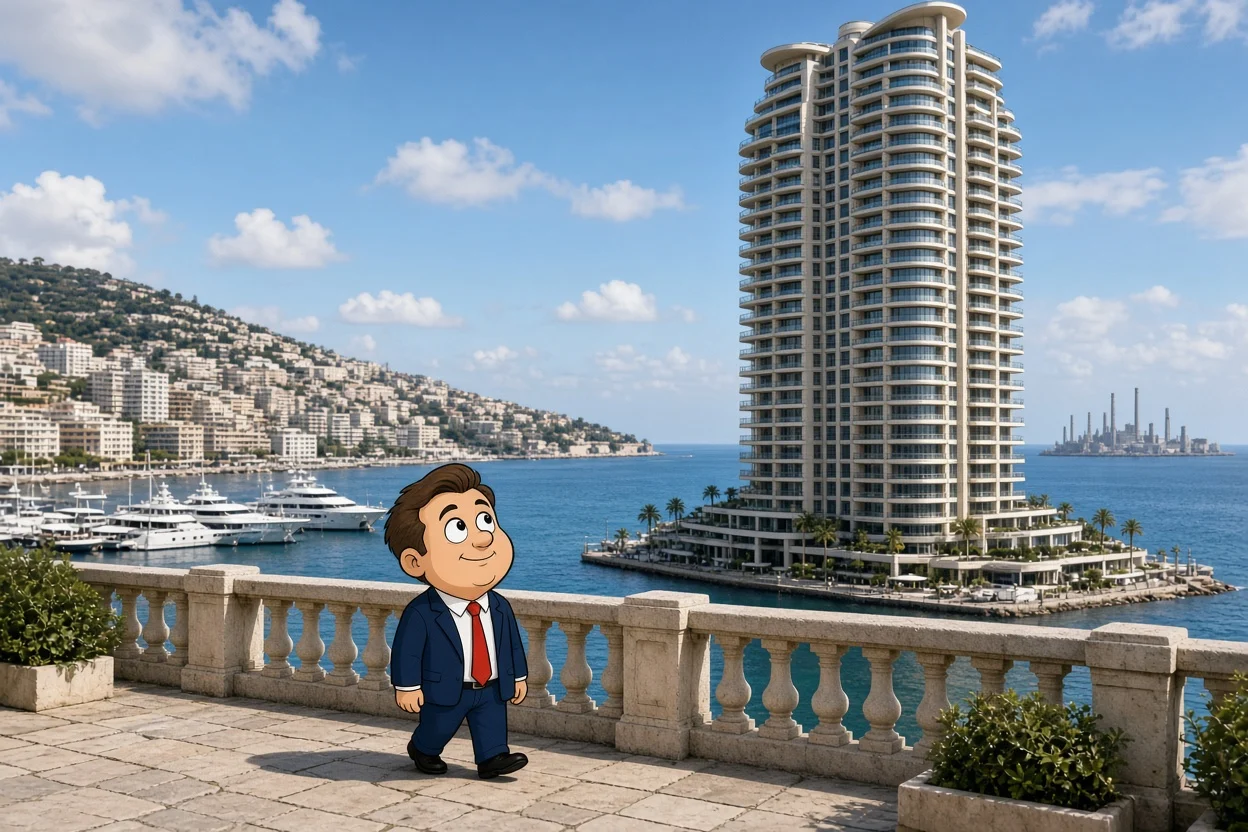
To a reader outside Ukraine, the juxtaposition may seem almost impossible: a country fighting for its survival, raising donations for equipment and medical care, while one of its wealthiest businessmen is linked to a Monaco residence reportedly worth €471 million. Yet understanding this contrast requires more than a photograph of a luxury apartment. It requires understanding how Ukraine’s post-Soviet economy produced its oligarchs, how war has damaged their businesses, and why personal wealth can remain enormous even when a country’s economy is under extraordinary strain.
The monaco transaction — and its timeline
On 21 April 2026 Bloomberg reported, citing Monaco property records and documents it reviewed, that Rinat Akhmetov’s SCM bought a five-floor, 21-room apartment in Le Renzo for €471 million (about $550 million); Euronews and Monaco Tribune repeated the report. SCM confirmed an investment in the project but did not disclose the price or terms and did not dispute the report. It said it invested on the primary market in 2021; Bloomberg says the deal was finalised in 2024. Those are two different milestones: the start of the investment and the closing. The available reports therefore give no basis for saying that the invasion prompted the purchase. SCM stated that the investment was made “in full compliance with the laws of Monaco” and that its details remain confidential under the investment agreement.
Akhmetov had already attracted international attention for luxury real estate. On 27 January 2020 the Financial Times reported (as relayed by LB.ua) that Akhmetov had bought Les Cèdres, a historic villa on the French Riviera, for about €200 million; Campari had announced a preliminary sale agreement on 1 August 2019 without naming the buyer. SCM Holdings confirmed the acquisition. Neither transaction, on its own, establishes wrongdoing. The legitimate public-interest question is how the rules governing large fortunes were designed.
Why ukraine has oligarchs
After the Soviet Union collapsed in 1991, Ukraine inherited enormous state-owned industrial assets: steelworks, coal mines, energy infrastructure and factories. During the transition to a market economy, ownership shifted into private hands. Weak institutions, opaque transactions, political patronage and concentrated ownership made this transformation very different from the ideal of open competition. According to Poland’s Centre for Eastern Studies (OSW), many Ukrainian oligarchs owe their fortunes to the privatisation of state assets at reduced prices and built monopolies or oligopolies and political influence over about 25 years (OSW Commentary, 15 November 2021). In 2012, OSW noted that in the power-company privatisation tenders DTEK, part of Akhmetov’s SCM, was either the only participant or faced only formal competition, while media reports of deliberate undervaluation were, in OSW’s words, difficult to verify. By 2023, OSW judged oligarchs’ political influence to be fading. This is an explanation of the system, not a legal finding that every acquisition by any particular businessman was corrupt.
Akhmetov’s SCM became a major force in steel, mining and energy, especially in eastern Ukraine. The overlap between major industrial fortunes and political power has long been part of the country’s debate about oligarchic influence. For foreign readers, the distinction is important: corruption is a documented structural concern in post-Soviet political economies, but a particular criminal allegation requires particular evidence. A luxury property cannot substitute for that evidence.
Can someone get richer while their country is at war?
A billionaire’s net worth is not a bank balance. It reflects the estimated value of businesses, investments, property and liabilities, and it can change with asset valuations, currency movements and market expectations. A person can own a very expensive residence while a company they control suffers losses. Conversely, expensive assets acquired before a war can remain in private ownership during it. The Monaco transaction does not, by itself, demonstrate that Akhmetov became wealthier during the invasion.
Indeed, Metinvest, in which SCM holds 71.24%, said on 26 October 2022 that production at its Mariupol plants, including Azovstal and Ilyich, had been suspended since 24 February 2022, that the city was occupied and that control could be restored only if the occupation ended. Akhmetov estimated the damage from Russian aggression to those two plants at about $11 billion in May 2022 ($10 billion pre-war capitalisation, $1 billion raw materials and finished steel; his own assessment, not an independent valuation). The Avdiivka coke plant was captured in February 2024, and Zaporizhstal was struck by missiles on 17 October 2026. Any account suggesting uninterrupted enrichment would ignore these losses. The relevant questions for public policy are whether privatisation and procurement were fair, whether large firms influenced market rules, and whether institutions can hold powerful actors to the same rules as everyone else.
Charity, reputation and public accountability
SCM said on 9 November 2026 that its businesses, the Rinat Akhmetov Foundation and FC Shakhtar had directed more than UAH 15 billion to the military, civilians and communities since February 2022. This is the company’s own figure; it includes in-kind aid, and no independent audit is cited in that statement. Support programmes and their beneficiaries matter and should not be erased from the story.
At the same time, large-scale philanthropy can generate favorable publicity for a business leader. It can be genuine assistance and a reputational benefit at once. Neither observation proves that the donor’s motives are insincere. The question for journalists is whether claims about donations, tax payments, ownership and public policy are sufficiently transparent to be examined.
The two economies of wartime ukraine
For many Ukrainians, the war is measured in displaced families, destroyed homes, military service and small recurring donations. The Monaco property is measured in hundreds of millions of euros. Comparing these realities is legitimate, but the figures should not be treated as interchangeable: a real-estate valuation is not cash that could automatically be transferred to Ukraine’s defense budget.
The larger issue is the political economy of reconstruction. Can Ukraine build competitive institutions that prevent business dominance from translating into privileged political access? Can future privatizations and public procurement withstand scrutiny? Can oligarchic fortunes be discussed with equal attention to documented assistance, wartime losses and the transparency of ownership?
Akhmetov’s properties are a reason to ask harder, more precise questions about the relationship between wealth, power and a society at war. No source we reviewed alleges that the Monaco purchase was unlawful.
Sources
- Bloomberg, 21 April 2026
- Euronews, 23 April 2026
- Monaco Tribune, 24 April 2026
- Forbes.ua, 23 April 2026
- SCM statement, 22 April 2026
- FT, 27 January 2020, via LB.ua
- Radio Free Europe/Radio Liberty, 27–28 January 2020
- Campari, 1 August 2019
- OSW, 15 November 2021
- OSW, 18 January 2012
- OSW, 13 June 2023
- Metinvest, 26 October 2022
- Metinvest, SCM ownership share
- GMK Center, Akhmetov’s $11bn estimate, 18 May 2022
- Zaporizhstal, 17 October 2026
- SCM/Metinvest Media, 9 November 2026
- Interfax-Ukraine, 10 November 2026
- Gordon, 9 November 2026
- Reuters, 19 February 2024, reporting Russia’s claim to control of Avdiivka coke plant, via ABC News


Leave a comment
Sign in with Google